
At a Glance
The core difference between a metal vs acrylic display case comes down to what you value more: structural rigidity and a premium frame aesthetic, or optical clarity and impact resistance at a lower weight.
If your priority is maximum visibility of the collectible — especially graded cards, trading cards, or delicate figures — an acrylic display case is typically the stronger choice. Acrylic transmits more light, resists shattering, and can be engineered into fully transparent enclosures with minimal visual distraction.
If your priority is structural durability, a rigid frame presence, or outdoor-grade weather resistance, a metal display case (usually aluminum) makes more sense. Metal frames are far more resistant to warping over time and provide a sturdy architectural feel that suits retail environments and heavy-traffic displays.
For most collectors and retail buyers in 2026, the practical recommendation is a hybrid approach: an aluminum frame paired with acrylic panels. This combines the rigidity and clean lines of metal with the clarity and lightweight advantages of acrylic — and it is the configuration used by the majority of professional display case manufacturers.
Types & Categories — Metal vs Acrylic Display Case Options
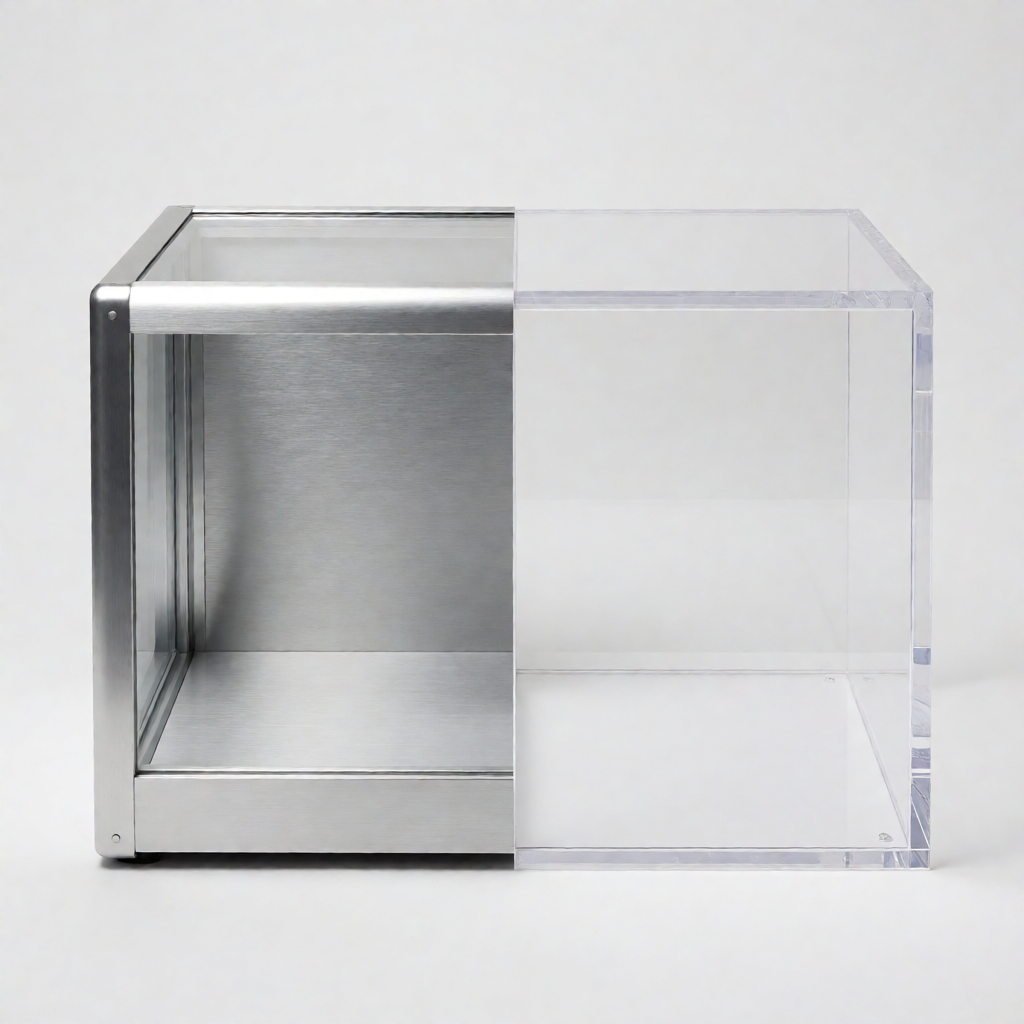
Display cases fall into a few recognizable categories, and the material you choose affects each one differently.
What type of display case is best for graded card collectors?
Graded card collectors — whether holding PSA, BGS, or similar slab-graded sports and trading cards — typically choose acrylic slab guards or acrylic-top display cases. The reason is straightforward: acrylic offers near-glass clarity without the weight, and it does not introduce any off-gassing or chemical interaction with the slab seal. A UV acrylic display case is the standard for long-term archival storage of slab-graded cards, blocking the majority of UV wavelengths that cause card deterioration.
Metal-only cases (frame-and-glass or frame-and-acrylic hybrid) are less common for slab collection because the opaque metal frame visually interrupts the view of the card. When metal is used in this context, it is almost always as a slim frame holding an acrylic front panel — not as a full metal enclosure.
What type of display case suits retail product showcases?
Retail environments often lean toward aluminum display cases or metal display enclosures because the frame structure withstands frequent handling, accidental bumps, and the visual demands of high-traffic storefronts. An aluminum frame paired with an acrylic front panel is the dominant configuration here: the metal provides durability and a clean, modern aesthetic, while the acrylic panel maintains product visibility.
For point-of-sale displays of smaller items — wallets, money clips, accessories — buyers commonly refer to top loader displays or open-front aluminum cases with acrylic sides. See our guide on sourcing money clips for B2B buyers for context on product-display pairings.
What type of display case is appropriate for museum and exhibition use?
Museum-grade displays prioritize optical clarity, UV protection, and archival safety. Cast acrylic (also called polymethyl methacrylate or PMMA) is the material of choice in this category. Unlike extruded acrylic, cast acrylic has superior optical clarity, better scratch resistance, and greater resistance to environmental stress cracking — all of which matter for long-term exhibition pieces.
Metal frames are occasionally used in museum settings for structural support, but the visible barrier is almost always cast acrylic. ASTM standards governing display materials for archival purposes emphasize inertness, non-yellowing properties, and UV filtration, which cast acrylic meets when properly formulated.
What type of display case works best for home collectible showcases?
Home collectors tend to favor fully acrylic display cases or acrylic card display cabinets because they are lightweight, easy to reposition, and offer unobstructed views from multiple angles. For everyday home use, a single-piece acrylic top-loader or a multi-compartment acrylic case is often more practical than a heavier metal-framed option.
If you carry a Pokemon binder or toploader collection, matching your storage system with a clear acrylic display case keeps everything in one visual language.
Comparison Table — Key Specifications Side by Side
| Specification | Acrylic Display Case | Metal (Aluminum) Display Case | Winner by Use Case |
|---|---|---|---|
| Optical Clarity (light transmission) | 92% (cast acrylic); ~88% (extruded) | N/A (opaque); depends on glazing material used in panels | Acrylic — retail product showcases, graded card displays |
| Weight (per square foot of panel) | ~0.5–0.7 lb/sq ft (3 mm thickness) | ~1.5–2.0 lb/sq ft equivalent frame structure | Acrylic — portable displays, home use, frequently moved cases |
| Scratch Resistance | Moderate (uncoated); high when hard-coated | High (surface-anodized aluminum resists abrasion well) | Metal — high-traffic retail, museum handles |
| Impact Resistance | 17–20× stronger than glass of equivalent thickness | High (does not shatter; absorbs impact through frame) | Tie — both outperform glass; acrylic wins on transparency under impact |
| UV Resistance (panel material) | Up to 99% UV block with coated/wavelength-filtered acrylic | Depends on glazing; aluminum frame itself blocks UV entirely | Acrylic with UV coating — archival and museum-grade protection |
| Cost (bulk, FOB China, per unit) | $3–$12 (simple top-loader); $15–$45 (full case, 50+ units) | $8–$20 (simple frame); $30–$80+ (full case with panels, 50+ units) | Acrylic — lower material and tooling cost |
| Customization (complexity) | High — easily CNC-milled, thermoformed, laser-cut into custom shapes | Moderate — requires metal framing, welding, or extrusion tooling | Acrylic — faster prototyping, lower MOQ for custom sizes |
| Longevity / Yellowing | Cast acrylic resists yellowing for 10+ years with UV stabilizers; extruded may yellow sooner | Does not degrade or yellow; powder coat may fade after several years outdoors | Metal — outdoor or high-UV environments without glazing |
| Fire Rating | UL 94HB (standard grade); some cast grades reach UL 94V-2 | Aluminum is non-combustible (melts at ~1220°F / 660°C) | Metal — fire safety compliance for commercial installations |
| Aesthetic Finish Options | Transparent, tinted (smoke, blue, red), frosted, mirrored | Powder-coated in any RAL color, anodized (natural, black, bronze), brushed, polished | Tie — depends on design intent |
Indicative FOB China bulk-order pricing for trade buyers — not a retail price and not a binding offer; final pricing depends on quantity, specification, and order schedule.
Buying Factors — What to Consider Before You Buy
Choosing between a metal and acrylic display case requires evaluating several interlocking factors. The “right” answer shifts depending on what you are displaying, where it will live, and how long you expect the case to remain in service.
How do you decide between acrylic and aluminum for your collection?
Start with the collectible. If you are displaying slab-graded cards, trading cards, or fragile memorabilia, clarity and UV protection are non-negotiable — acrylic with a UV-blocking coating is the clear winner. If you are displaying hardgoods, products for retail, or durable collectibles that will see heavy handling, an aluminum frame provides better structural longevity.
Next, consider the environment. Indoor, climate-controlled environments favor acrylic because it maintains optical clarity without the condensation issues that can affect metal frames in humid conditions. Outdoor or semi-outdoor environments favor aluminum because the frame will not warp, and any acrylic panels can be specified with UV-stabilized formulations to resist yellowing.
How important is weight when choosing a display case?
Weight is a significant factor for collectors who rearrange their displays regularly, for retailers who rotate shelf products, and for anyone shipping display cases in bulk. A standard 9″ × 12″ acrylic top-loader weighs under 2 ounces. The same-sized aluminum frame with acrylic panels weighs 8–12 ounces. For a shipment of 500 units, that difference translates to roughly 25–50 lbs of additional freight weight — which directly affects your landed cost.
If your procurement strategy includes 1688-to-Amazon fulfillment, this weight difference is exactly the kind of variable that shifts your margins.
Which material offers better long-term clarity?
This is where the grade of acrylic matters significantly. Extruded acrylic is cheaper to produce and is suitable for short-to-medium-term display applications. Cast acrylic, however, is denser, has fewer internal stresses, and maintains its clarity far longer — often 10+ years without noticeable yellowing when UV-stabilized.
Uncoated acrylic will eventually scratch and haze with repeated cleaning. A hard-coated acrylic panel, or one specified with an anti-scratch lacquer, extends that timeline considerably. This is why UV acrylic versus glass display comparisons consistently show acrylic as the preferred material for collectors who clean their cases regularly.
Can display cases be customized for specific sizes and designs?
Both materials can be customized, but the complexity and cost differ.
Acrylic customization is relatively straightforward: sheets are CNC-cut or laser-cut to exact dimensions, edges are polished or beveled, and panels can be thermoformed into curved shapes. Minimum order quantities (MOQs) for custom acrylic cases typically start at 50–100 units for a new size, though simple size variations from existing tooling can be done at lower MOQs.
Metal customization involves extrusion profiles, welding, and powder-coating. New extrusion tooling is expensive and has a long lead time (6–10 weeks), so most manufacturers work from existing frame profiles and cut them to length. This means your size options are more constrained unless you are ordering at volume. Custom powder-coat colors are available at any quantity but add a per-unit cost.
For a detailed look at how customization affects cost, see our guide on 4-pocket vs 9-pocket vs 16-pocket binders — the same principles of volume, tooling, and configuration apply to display cases.
Price & Cost — How Much Does Each Option Cost?
Pricing for display cases varies widely based on size, material thickness, finish, and order quantity. The figures below reflect bulk FOB China pricing for trade buyers placing orders of 50+ units.
| Product Type | Acrylic (USD/unit, 50+ units) | Metal/Aluminum Frame (USD/unit, 50+ units) | Metal + Acrylic Hybrid (USD/unit, 50+ units) |
|---|---|---|---|
| Single card top-loader display | $3–$6 | $5–$9 | $7–$12 |
| Slab guard display case (9×12) | $8–$15 | $12–$22 | $15–$28 |
| Multi-card showcase (6–12 slots) | $18–$35 | $28–$55 | $35–$65 |
| Full cabinet/display case (large) | $45–$90 | $70–$140 | $80–$160 |
Several variables move the price within each range:
- Material thickness: 3 mm acrylic is standard; 5 mm or 8 mm options increase cost by 30–80%.
- UV coating: Adds $0.50–$2.00 per unit depending on coverage and formulation.
- Powder-coat color: Standard colors (black, white, silver) are included; custom RAL colors add $0.30–$1.00 per unit.
- Order volume: Prices drop 10–25% at 200+ units and another 10–15% at 500+ units.
- Packaging: Individual poly bags are standard; custom gift-box or retail-ready packaging adds cost.
For buyers comparing sourcing options, our sourcing guide for B2B money clips covers similar cost-structure dynamics that apply to display case procurement as well.
Request a bulk FOB quotation with your target sizes and quantities to get precise pricing for your order.
Pros & Cons — Metal vs Acrylic at a Look
Acrylic Display Case
Advantages:
- Superior optical clarity (up to 92% light transmission) — ideal for showcasing collectibles where visibility is paramount
- Lightweight — easy to ship in bulk and to reposition on shelves or display tables
- Excellent UV protection when coated — critical for preserving paper-based collectibles like graded cards
- Easily customized to non-standard sizes without expensive new tooling
- Does not corrode or rust — suitable for humid indoor environments
- Can be produced in transparent, tinted, frosted, or mirrored finishes
Disadvantages:
- Scratches more easily than metal — requires careful cleaning with acrylic-safe products only
- Lower-grade extruded acrylic can yellow over time, especially under direct sunlight or UV exposure
- Less structurally rigid than metal — large unsupported spans may flex or bow
- Can develop static charge, attracting dust
- Some formulations are flammable (UL 94HB); fire-rating compliance requires careful specification
Metal (Aluminum) Display Case
Advantages:
- Extremely durable frame — resistant to warping, cracking, and impact damage
- Does not yellow or degrade over time
- Non-combustible — aluminum melts at very high temperatures and does not contribute to fire spread
- Can be powder-coated in any color for brand-matched retail displays
- Provides a premium, architectural feel that appeals in high-end retail and museum settings
- Frame structure protects the glazing material (acrylic or glass) from direct impact
Disadvantages:
- Opaque — the frame blocks part of the viewing area, reducing the visible display surface
- Heavier — increases shipping costs and makes repositioning more labor-intensive
- Higher material and tooling cost — especially for custom extrusion profiles
- Condensation can form inside metal frames in high-humidity environments if not properly sealed
- Custom sizes require more engineering time and higher MOQs than acrylic
Additional Considerations — Other Display Case Materials
While metal and acrylic dominate the market, a few other materials appear in specific applications and are worth understanding.
Glass remains the traditional choice for museum and high-end retail displays. It offers scratch resistance and infinite clarity but is heavy, fragile, and expensive to ship. For most collectors and B2B buyers, acrylic has replaced glass as the primary glazing material due to its lighter weight and shatter resistance. See our UV acrylic vs glass display comparison for a detailed breakdown of when glass still makes sense.
PVC (polyvinyl chloride) is sometimes used for low-cost, single-card sleeves and top-loaders. It is cheaper than acrylic but offers inferior clarity, poor UV resistance, and a higher risk of off-gassing that can damage card surfaces over time. PVC is not recommended for archival or long-term display of valuable collectibles.
Polycarbonate is an engineering plastic that is far more impact-resistant than acrylic — up to 250× stronger than glass. It is used in high-security display applications where vandalism resistance is a priority. However, polycarbonate scratches more easily, costs more, and can yellow under UV exposure unless coated. It is rarely used for standard collectible display cases but appears in commercial and institutional settings.
When evaluating any display case material, consider the full lifecycle — not just the upfront cost. A slightly more expensive cast acrylic case with UV coating will outperform a cheap extruded acrylic case in a 5-year comparison, particularly for collectors who prioritize preservation.
Evidence & Practical Notes
Field note: In our experience sourcing and evaluating display cases across multiple collector segments, the most common mistake buyers make is specifying uncoated extruded acrylic for graded card displays. Within 18–24 months, yellowing becomes visible on the interior panels, and the display quality degrades noticeably. Always request cast acrylic with a UV-stabilized coating for any application involving paper-based collectibles.
Practical limitation: Aluminum frames are often assumed to be “low maintenance” because they don’t yellow, but the powder-coated finish can chip or scratch during shipping and installation. Once the coating is compromised, the underlying aluminum is exposed to moisture and can oxidize, leading to white corrosion marks that are difficult to repair cosmetically. Buyers should specify touch-up kits or order 2–3% spare units for field repairs.
Buyer takeaway: For the majority of collectible display applications — especially graded cards, trading cards, and memorabilia — a hybrid aluminum-frame-with-acrylic-panel case offers the best balance of durability, clarity, and cost. Pure acrylic cases are acceptable for low-traffic home displays, and pure metal cases are rarely optimal for visibility-critical applications. The hybrid configuration is what most professional manufacturers default to for good reason.
Choosing a Manufacturer — What to Look For
Selecting a manufacturer for display cases involves evaluating more than price. Key factors include material sourcing (cast vs extruded acrylic, aluminum alloy grade), quality control processes, customization capabilities, and lead time consistency.
Some manufacturers specialize in single-material solutions — either all-acrylic or all-metal — while others, like the operation behind Top Card Case, offer both and can recommend the optimal configuration for your specific use case. As a manufacturer, our approach to this is to evaluate the collectible type, display environment, and budget together before recommending a material path — because the right choice is rarely the most expensive one.
When evaluating suppliers, ask about:
- Whether they use cast or extruded acrylic and why
- UV transmission specifications for their panel materials
- Aluminum alloy grades and powder-coat durability testing
- MOQ flexibility for custom sizes and colors
- Sample lead time and whether prototype cases are available before bulk production
For businesses sourcing display cases alongside complementary products, understanding the full cost structure matters. Our guide on best card holder selection for B2B sourcing covers procurement frameworks that apply equally to display case sourcing.
Contact our team to discuss your display case specifications, size requirements, and volume targets.
Sources & References
- ASTM standards — www.astm.org
- UV acrylic display case — topcardcase.com
- sourcing money clips for B2B buyers — topedcwallet.com
- Pokemon binder or toploader collection — topcardcase.com
- 1688-to-Amazon fulfillment — topcardcase.com
- 4-pocket vs 9-pocket vs 16-pocket binders — topcardcase.com
- Request a bulk FOB quotation — topcardcase.com
- best card holder selection for B2B sourcing — topedcwallet.com