
At a Glance
Sourcing graded card protection products from 1688 and reselling through Amazon FBA can be profitable, but the margin lives or dies in the shipping and fulfillment layers — not in the product cost itself. A typical 1688 to Amazon cost breakdown for card accessories comes down to three numbers: the factory FOB price, the all-in landed cost after freight and duties, and the Amazon fee stack that eats into every sale.
For most card-supply categories, the realistic net margin sits between 18% and 35% once you account for freight, customs, FBA fees, and Amazon referral charges. Thin margins cluster in commodity top loaders; healthy margins cluster in value-added SKUs such as custom-corner-protector sets and branded slab protectors. The decisive factor is unit weight and pack density — lighter, compact bundles move profitably by air or express, while heavier bulk shipments need sea freight to stay viable.
If you are comparing options right now, the practical recommendation is to start with a small test order of your highest-margin category through an experienced OEM or ODM partner on 1688, then scale into a hybrid LCL-then-FCL plan once the Amazon side validates demand. That approach keeps your risk controlled while you learn which cost variables actually move your margin.
Types & Categories
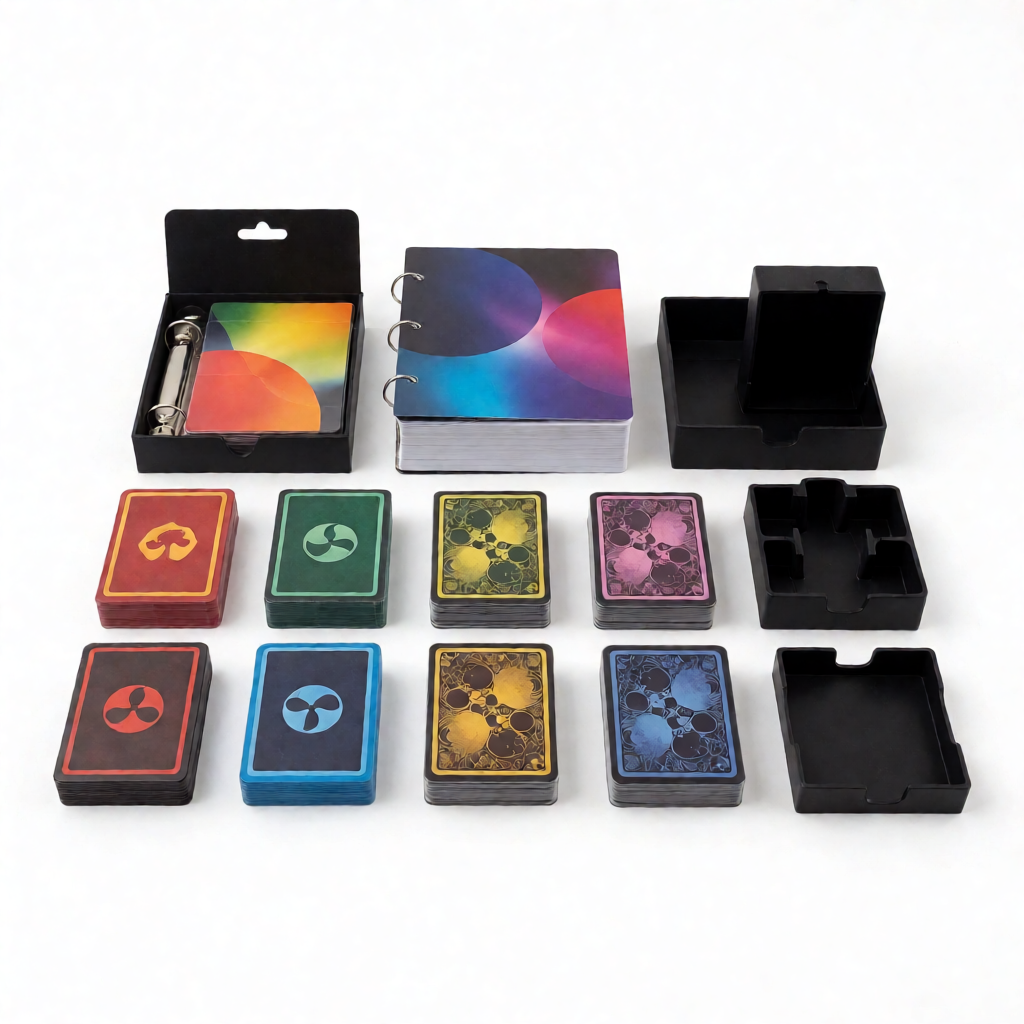
Understanding what you are sourcing matters as much as knowing how much it costs. Card accessories span a few distinct product families, each with its own cost drivers and Amazon-fee profile.
What graded card protector types are available on 1688?
Graded card protectors — including slab sleeves, PSA slab guards, and rigid top loaders — are the most common sourcing category. These items share simple manufacturing (mostly injection-molded polypropylene or polystyrene), which keeps per-unit costs low. The trade-off is intense competition on Amazon, where thin margins are normal unless you differentiate through packaging, bundling, or private-label branding.
Which card-safety accessories carry better margins?
Corner protectors, slab protectors, and bundled grading-supply kits tend to deliver stronger margins because they involve slightly more complex assembly or multi-piece configurations. Buyers often source these as part of a curated product line rather than as single-item SKUs. A well-designed bundle — for example, a corner-protector pack paired with a slab guard — raises average order value without proportionally raising FBA fees, which is why this segment attracts private-label brand owners.
Where do top loaders and bulk storage fit?
Bulk top loaders and larger-format holders serve different use cases. They are heavier and take up more dimensional weight in FBA, which pushes fulfillment fees upward. They remain viable when ordered in high volume through sea freight, but the per-unit margin pressure is steeper than for compact accessories. This is the category where shipping cost mistakes are most visible.
Comparison Table
The table below compares common card-accessory categories by their typical sourcing profile. Use it to identify where your attention should go first.
| Product Category | Typical FOB Range (USD/unit) | Weight Profile | Amazon Fee Pressure | Margin Potential |
|---|---|---|---|---|
| Basic top loaders | $0.18–$0.45 | Light | Low–Medium | 20–30% |
| Premium top loaders (thicker stock) | $0.35–$0.75 | Light–Medium | Low–Medium | 25–35% |
| Slab guards / PSA-style protectors | $0.40–$0.95 | Light | Medium | 25–40% |
| Corner protectors (bulk packs) | $0.25–$0.60 | Very light | Low | 30–45% |
| Graded-card bundle kits | $1.20–$2.80 | Medium | Medium | 25–35% |
Indicative FOB China bulk-order pricing for trade buyers — not a retail price and not a binding offer; final pricing depends on quantity, specification, and order schedule.
Several patterns jump out. Lighter, denser products dominate the most favorable margin slots because FBA fees are heavily weight- and size-dependent. Bundles improve margin by lifting average revenue per unit while staying within the same fulfillment-fee band. Heavier single items — especially oversized top loaders — require disciplined freight planning to avoid margin erosion.
Key Buying Factors
Before committing to a supplier or a shipping method, you need clarity on four decision factors. These are the variables that actually determine whether your 1688-to-Amazon model works.
How important is MOQ for unit cost?
MOQ is one of the most significant levers in the cost equation. On 1688, many suppliers set tiered pricing: the first tier might start at 500–1,000 pieces, with meaningful price drops at 3,000, 5,000, and 10,000+ units. For private-label card accessory brands, the sweet spot is usually the 2,000–5,000-piece range for a first order — enough volume to lock a better rate without overcommitting capital. If you are an eBay-to-Amazon product expander testing demand, start even smaller and treat higher MOQs as a scaling trigger, not a starting condition.
What material and durability factors matter most?
Card protection materials vary by polymer grade and thickness. Polypropylene is standard for rigid top loaders and sleeves; polystyrene is common for heavier slab guards. What buyers should check is clarity, scratch resistance, and the rigidity rating — not just the “thickness number” on a spec sheet. Material choice also affects the manufacturing tolerance window, which feeds directly into rejection rates and hidden costs.
How does certification influence landed cost?
Certifications are non-negotiable for import compliance and Amazon listing eligibility. For non-electronic card accessories, material-safety standards and packaging compliance dominate. Some buyers assume certifications add heavy cost, but the reality is more nuanced: a reputable ISO-certified supplier already absorbs basic quality systems into overhead. What actually adds cost is custom testing, third-party lab reports, and documentation preparation — especially if your product touches electronics (for example, illuminated display cases). Plan for compliance budgeting upfront rather than discovering it at customs.
What lead time should you expect?
Typical production lead time for molded card accessories sits in the 15–25 day range after deposit, depending on complexity and order size. Shipping adds another variable: express air is 5–8 days, LCL sea freight is 25–35 days, and FCL sea freight is 30–40 days. A reliable supplier communicates timeline risks early. Delays compound quickly in an FBA environment — stockouts hurt ranking, and rushed air freight destroys margin.
Terms Buyers Should Know
| Term | What it means | Why it matters when buying |
|---|---|---|
| FOB (Free on Board) | Supplier covers costs and risk until goods are loaded onto the shipping vessel at the origin port. | Determines where your cost responsibility begins;FOB prices are the standard benchmark for comparing supplier quotes. |
| LCL (Less than Container Load) | Shared container shipping for smaller cargo volumes that do not fill a full container. | Cheaper than air freight for medium orders, but transit times are less predictable and documentation is more complex. |
| FCL (Full Container Load) | An entire shipping container booked exclusively for one buyer’s cargo. | Offers the lowest per-unit freight cost at scale, but requires sufficient order volume to justify the commitment. |
| Lead Time | Total elapsed time from order confirmation to goods ready for shipment, excluding transit. | Directly impacts inventory planning and cash flow; longer lead times require larger safety-stock buffers. |
Price & Cost Breakdown
This is the section most buyers focus on: the actual 1688 to Amazon cost analysis for card accessories. The numbers below are illustrative but grounded in common industry practice. Use them as a calculation framework rather than a fixed price list, because freight, duties, and Amazon fee bands shift regularly.
Example scenario: corner protectors and slab guards
Assume a buyer sources a mixed SKU bundle — corner protectors and slab protectors — at an average FOB price of $0.55 per unit, ordering 3,000 units.
- Product cost (FOB): $0.55 × 3,000 = $1,650
- Domestic China freight to port: ~$120
- Sea freight (LCL estimate): ~$380
- Customs duty (estimated 5–7% on declared value): ~$115
- Customs broker & port fees: ~$180
- Inland freight to Amazon FBA warehouse: ~$150
- Total landed cost: approximately $2,595, or $0.865 per unit
On the Amazon side, assume a retail price of $12.99 per pack and an ASIN that falls into the standard small-standard size tier.
- Amazon referral fee (typically ~15% for Collectibles category): ~$1.95 per unit
- FBA fulfillment fee (small-standard): ~$3.40 per unit
- Monthly storage (minimal for fast-moving stock): ~$0.15 per unit
- Total Amazon fees: approximately $5.50 per unit
Subtracting the landed cost ($0.865) and Amazon fees ($5.50) from the retail price ($12.99) leaves a gross margin of roughly $6.62 per unit — about 51% gross margin before advertising, returns, and administrative costs. Once those variables are factored in, the net margin typically lands between 25% and 35%, which is competitive for this product type.
How much does shipping from China to Amazon FBA warehouses actually cost?
Shipping cost is the largest post-FAB variable. Air or express freight runs significantly higher per kilogram than sea freight, but it is the only viable option for time-sensitive replenishment. For slower-moving inventory, LCL sea freight is the default economic choice, with FCL becoming attractive once order volume consistently exceeds 15–20 CBM. Many sellers use a hybrid strategy: initial LCL trial, then FCL once demand stabilizes.
What hidden costs should you watch for?
Hidden costs are where margins quietly disappear. The most common ones include:
- Peak-season freight surcharges during Q4, which can raise sea-freight rates by 30–60%.
- Customs valuation adjustments if declared values are questioned, triggering delays and storage fees.
- Repackaging or labeling costs if the supplier does not meet Amazon FNSKU labeling requirements precisely.
- Inventory aging fees when product moves slower than forecast.
- Return and damage replacement costs that are rarely built into initial margin models.
Plan for a 10–15% buffer on your initial cost model to absorb these variables without derailing profitability.
Which card accessory categories offer the best margin on Amazon?
Compact, lightweight bundles and private-labeled graded-card protection sets consistently deliver the best margins. Items such as card corners, slim slab sleeves, and multi-piece grading supplies kits avoid the dimensional-weight penalties that hurt bulkier top loaders. Bundled SKUs also benefit from higher average selling prices within the same FBA fee band, which is why they appear frequently in successful private-label playbooks.
For further reading on product positioning and protection styles, see our guides on Pokemon Binder vs Toploader Binder and UV Acrylic vs Glass Display. If you want a deeper look at material choices and procurement standards for card accessories, our guide on Best Card Holder Selection for B2B Sourcing covers sourcing fundamentals that apply directly to this model.
Pros & Cons
Every sourcing model carries trade-offs. Here is a straightforward look at what to expect when you move from 1688 sourcing into Amazon FBA resale.
Advantages of 1688 sourcing for Amazon FBA card products
- Low product cost. Molded card accessories are inexpensive at source, leaving room for competitive retail pricing and healthy gross margins.
- Flexible customization. Many 1688 suppliers offer OEM and ODM services, allowing private-label branding, custom packaging, and tailored bundle configurations.
- Fast product iteration. Short production runs let you test new SKUs with relatively low capital commitment before committing to large batches.
- Volume discounts. Tiered pricing rewards scaling orders, and sea freight amplifies those savings at higher quantities.
Risks and disadvantages
- Quality variability. Without strict specification control and pre-shipment inspection, defect rates can erode margins through returns and negative reviews.
- Shipping volatility. Freight rates and transit times fluctuate, especially during peak seasons, making cost forecasting less precise than domestic sourcing.
- Compliance complexity. Import documentation, customs valuation, and Amazon policy requirements add administrative overhead that new importers often underestimate.
- Brand differentiation barrier. Commodity products are easy to source and equally easy for competitors to copy, which drives price competition on Amazon over time.
The overall verdict: 1688-to-Amazon sourcing works best when you treat it as a disciplined operating model — not a quick arbitrage opportunity. Margins reward buyers who plan shipping strategically, control quality proactively, and differentiate through bundling and branding rather than competing solely on price.
Evidence & Practical Notes
Field note: Buyers who calculate margin using only the product cost and the Amazon fee schedule consistently overestimate profitability. The freight and customs layers — often totaling $0.15–$0.40 per unit depending on shipping mode and order size — are where most first-time importers miss their target margin. Run the full landed-cost model before committing to a large order.
Practical limitation: LCL sea freight introduces documentation complexity and less predictable transit windows compared to FCL. If your order volume stays below 10–12 CBM, the per-unit savings are real but manageable only if you have buffer stock and flexible replenishment timing. Rushing LCL shipments through expedited channels cancels much of the cost advantage.
Buyer takeaway: Start small, validate demand, and scale shipping mode only after confirmable sell-through. A 500–1,000 unit air-freight test order followed by a 3,000-unit LCL reorder gives you real data on velocity, defect rate, and true landed cost before you commit capital to FCL volumes.
Manufacturer Spotlight
After reviewing the cost structure, it helps to see how a compliant manufacturing partner operates inside these parameters. Here is how the industry works — and how we meet these standards.
As a manufacturer, our approach to this starts with the cost variables that matter most to an Amazon FBA seller: unit pricing at scale, consistent quality, and shipping-ready packaging. We operate under ISO 9001 quality management and IATF 16949 automotive-grade process controls, which means defect tracking, material traceability, and incoming-quality inspection are built into the production flow rather than added afterward. For buyers evaluating 1688 to Amazon cost analysis for card accessories, that baseline reduces the risk of costly quality failures at the destination.
Our facility supports both standard catalog production and custom OEM/ODM development. If you are building a private-label line of graded card protectors, slab guards, or corner-protector bundles, we work from your specifications — dimensions, material grade, packaging, and labeling — to produce inventory that ships FBA-ready. We also recommend that buyers request a pre-shipment photo inspection and, where feasible, third-party quality verification before the cargo leaves the factory. That step catches specification drift before it becomes a return-rate problem.
From a logistics perspective, we coordinate both air-express and sea-freight shipping routes, with LCL and FCL options depending on order volume. Buyers should plan lead time assuming 15–25 days production plus transit, and build in a seasonal buffer for Q4 freight surcharges. Our team supports documentation preparation and packaging compliance so the handoff to your freight forwarder is smooth.
For additional context on product comparison and sizing decisions, you may also find these resources useful: 4 vs 9 vs 16 Pocket Binder and Business Card Holder Sourcing Guide.
Sources & References
- Pokemon Binder vs Toploader Binder — topcardcase.com
- UV Acrylic vs Glass Display — topcardcase.com
- Best Card Holder Selection for B2B Sourcing — topedcwallet.com
- Request a Bulk FOB Quotation — topcardcase.com
- 4 vs 9 vs 16 Pocket Binder — topcardcase.com
- Business Card Holder Sourcing Guide — topedcwallet.com