

At a Glance — Key Takeaways and Recommended Approach
Choosing a reliable manufacturer for graded card protectors comes down to one question: can this factory consistently produce products that meet exacting tolerances, material specifications, and volume requirements without quality escapes?
Direct answer: You vet a protector factory by combining document verification, an on-site or virtual audit, certification cross-checks, sample evaluation, and reference validation before committing to a purchase order.
Recommended approach: Start with a documented audit checklist covering certifications, quality processes, capacity, and customization capability. Then request physical samples matched to your specification. Only proceed to a trial order after you have verified the factory’s ability to hold tolerances and maintain consistent output across production batches.
When to move fast: If you are sourcing for a grading company bulk order, a private label card shop launch, or a sports card distributor procurement program, factor lead time and capacity into your decision alongside quality — a factory that cannot scale or cannot hold dimensional tolerances will create operational risk regardless of price advantage.
Types & Categories — Card Protector Product Segments

Understanding the product categories helps you communicate requirements precisely and evaluate whether a manufacturer has the right tooling and materials for your application.
What type of slab guard or top loader do you need?
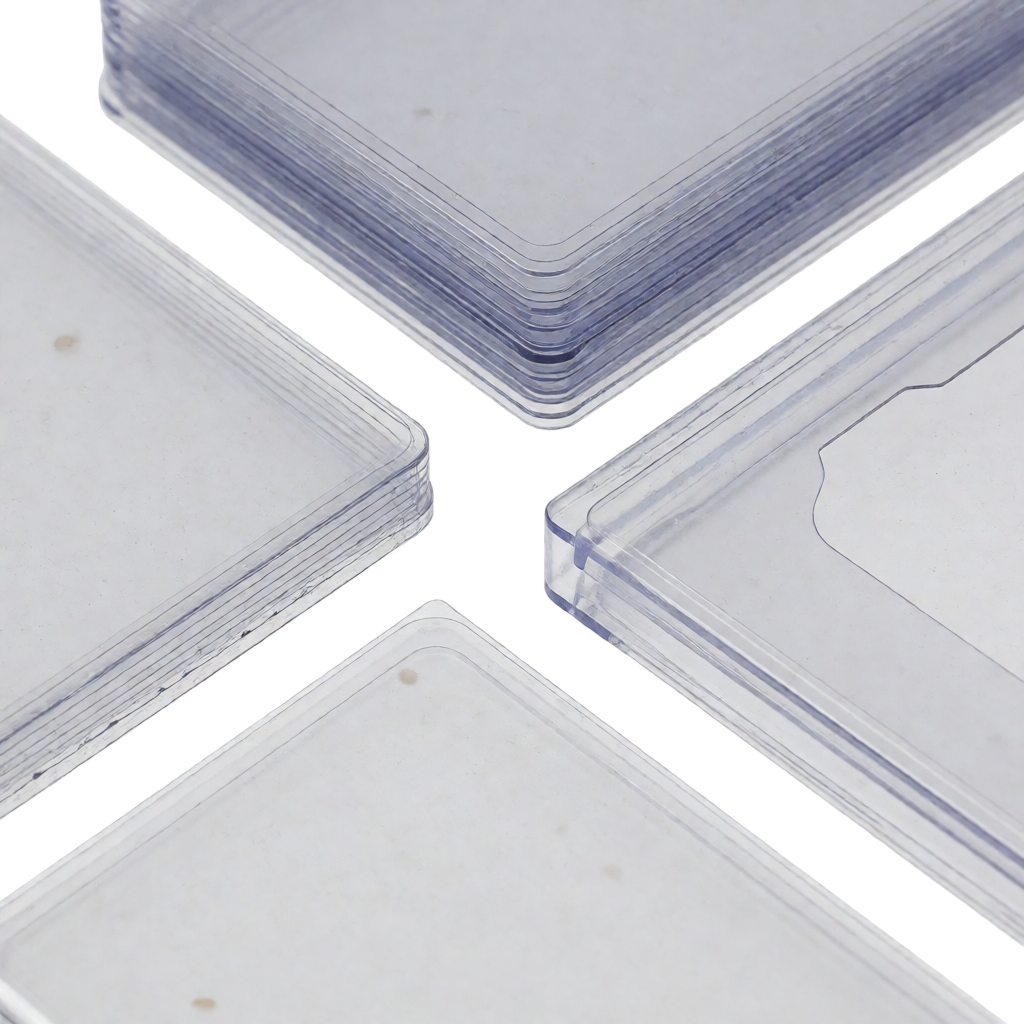
Graded card protectors (slab guards / slab protectors) — Rigid sleeves designed to fit over encapsulated cards (PSA, BGS, SGC slabs). These require precise internal dimensions and high-clarity materials to avoid condensation or scratching. Tolerance is typically within ±0.5 mm for length and width.
Top loaders — Single-card rigid sleeves for raw or ungraded cards. Available in various thicknesses (usually 0.30 mm to 0.45 mm) and sizes (standard 2.5 × 3.5 in, large size, international size). These are the highest-volume product category and the most competitive on price.
Corner protectors — Triangular or curved inserts placed on card corners before slabbing or long-term storage. Materials range from plastic to foam-backed options. They are low-cost add-ons but require consistent molding quality to avoid burrs or deformation.
Graded card sleeves — Inner sleeves and anti-static polypropylene sleeves used inside slab guards or top loaders. Material purity and anti-static properties are critical here — poor-quality sleeves can off-gas and damage card surfaces over time.
For buyers evaluating factory capability, product diversity matters less than depth in each category. A factory that specializes in slab guards and top loaders with proper mold inventory and material sourcing will typically outperform a generalist producer who trades tooling between unrelated product lines.
If you are comparing packaging formats, our Pokemon Binder vs Toploader Binder comparison guide outlines the structural differences that affect card preservation and retail presentation.
Comparison Table — Factory Evaluation Criteria at a Glance
The table below summarizes the core dimensions you should score when comparing potential manufacturers. Each dimension carries different weight depending on your order profile.
| Evaluation Dimension | Minimum Standard | Preferred Standard | Weight for Small Buyers | Weight for Volume Buyers |
|---|---|---|---|---|
| ISO 9001 certification | Required | Current certificate with online verification | Medium | High |
| IATF 16949 certification | Preferred | Current certificate | Low | High |
| In-house CNC machining | Required for precision molds | In-house tooling + surface finishing | High | Medium |
| Monthly production capacity | 50,000+ units | 200,000+ units | Medium | High |
| Sample turnaround time | 5–7 business days | 3–5 business days | High | Medium |
| Quality inspection protocol | IQC + IPQC + OQC | Full traceability + AQL sampling | High | High |
| OEM / ODM capability | Custom packaging | Full product development from spec | Medium | High |
| Reference track record | 2+ verifiable clients | 5+ clients in your market segment | Medium | High |
Buying Factors — How to Vet a Protector Factory
Vetting a protector factory requires a structured approach. Below are the dimensions that separate reliable manufacturers from risky ones.
What certifications should a card protector manufacturer hold?
A legitimate factory audit card protectors process should begin with document verification. Two certifications are most relevant:
ISO 9001 — This is the baseline quality management standard. It confirms the factory has documented procedures for production control, corrective actions, and continuous improvement. You can verify ISO certificates through the International Organization for Standardization (ISO) database or via the issuing body’s registry. Request the certificate number, issuing body, validity period, and scope of certification before any site visit.
IATF 16949 — Originally developed for automotive supply chains, this certification is increasingly adopted by manufacturers producing precision plastic components, including card protectors. It signals a higher level of process control, defect prevention, and supply chain management than ISO 9001 alone. If your target market involves grading companies or commercial distributors, IATF 16949 becomes a differentiator rather than a checkbox.
Additional verification steps:
- Request original certificate documents, not screenshots
- Cross-check certificate numbers on the issuer’s website
- Confirm the certification scope includes the specific products you intend to order
- Check for surveillance audit dates — a certificate with expired surveillance audits may indicate maintenance gaps
What does a factory audit for card protectors involve?
A thorough audit follows the production flow from incoming materials through finished goods. Organize your checklist by zone:
Incoming Material Control (IQC)
- Verify material supplier qualifications and certificates of conformity (CoC)
- Check material storage conditions — PP and PET sheets should be stored away from UV exposure and moisture
- Look for incoming inspection records and material traceability
Injection Molding / Cutting Area
- Inspect machine maintenance logs
- Observe environmental conditions (dust control is critical for optical clarity)
- Check whether molds are stored properly when not in use
- Evaluate whether operators follow setup and first-article inspection procedures
Assembly and Packaging
- Review work instructions and visual standards
- Check anti-static handling procedures
- Verify that packaging materials meet your specification (box material, insert type, labeling)
Quality Testing and Outgoing Inspection (OQC)
- Confirm testing equipment is calibrated
- Review AQL sampling plans
- Check finished goods storage and shipping preparation
How to evaluate a factory’s quality control process?
Quality control is where theoretical capability meets actual output. During a vetting process, ask the factory to walk you through their inspection workflow and request sample inspection records.
Key indicators of a mature QC system:
- IQC (Incoming Quality Control): Raw material verification with CoC cross-referencing
- IPQC (In-Process Quality Control): First-article inspection, in-process sampling, and dimension checks on molded parts
- OQC (Outgoing Quality Control): Final inspection against approved samples, packaging verification, and shipment documentation
Ask specifically about their AQL (Acceptable Quality Level) standards. A factory using AQL 2.5 for critical dimensions and AQL 4.0 for cosmetic defects is applying commercially reasonable thresholds. A factory with no defined AQL or one that accepts AQL 6.5 or higher for critical specs is a risk.
Request to see defect classification records and corrective action reports from the past six months. A factory that can produce these documents transparently demonstrates maturity. One that deflects or cannot produce them has something to hide.
What are the red flags when vetting a protector factory?
Certain signals consistently predict sourcing failures. Watch for these:
Certification red flags: A certificate that cannot be verified online, a scope that excludes your product category, or a certificate that expired more than six months ago. Some factories display counterfeit certificates — always verify through the issuing body.
Capacity mismatch: A factory claims 500,000 monthly output but operates fewer than ten machines. Capacity claims should align with observable equipment count, shift patterns, and floor space.
No sample policy: A factory that refuses to provide pre-production samples or charges unreasonable sample fees is often managing cash flow more than product quality.
Poor communication: Slow or vague responses during the inquiry phase rarely improve after the order is placed. Response time during vetting is a leading indicator of post-order responsiveness.
No facility visibility: A factory that consistently postpones or refuses on-site or virtual audits is avoiding scrutiny. Legitimate manufacturers welcome verification.
Pricing that is too low: If a quote is 30–40% below market range for equivalent specifications, investigate the material grade and process controls. Significant underpricing often reflects thinner material gauges, recycled content without disclosure, or skipped inspection steps.
How to assess OEM, ODM, and customization capability?
Customization readiness separates contract manufacturers from commodity producers. When evaluating a factory’s OEM and ODM capability, consider:
Tooling ownership: Does the factory own its molds, or does it subcontract molding? In-house mold ownership means faster iteration, better dimensional control, and lower per-unit costs at volume. See how our UV acrylic vs glass display comparison explores the trade-offs between in-house finishing and outsourced processes.
Material sourcing: Can the factory source specific polymer grades (e.g., optical-clear PP, anti-static PET) directly, or must they rely on trading companies? Direct material sourcing reduces lead time and cost variance.
Design support: For ODM projects, does the factory have engineering staff who can convert your specification into manufacturable designs, or do they only produce from provided artwork? Engineering support reduces development risk for new product launches.
Private label readiness: If you are launching a card shop private label, the factory should demonstrate experience with custom packaging, labeling, and barcode integration. Request examples of previous private label work.
How to verify a factory’s track record and client references?
Reference checking is often overlooked but highly predictive. Ask for three to five references in your geographic region or market segment. Contact them directly — do not rely on references the factory selects without your ability to reach alternative contacts.
Questions to ask references:
- Did the factory meet agreed specifications consistently?
- Were defect rates within acceptable ranges?
- How did the factory handle non-conforming shipments?
- Would you place a repeat order?
If the factory cannot provide verifiable references, treat this as a moderate risk signal and compensate with stricter sample approval and trial order terms.
Price & Cost — What to Expect from Manufacturer Pricing
Understanding cost drivers helps you evaluate quotes objectively and avoid the trap of selecting the lowest-priced option without scrutiny.
Cost variables for graded card protectors:
- Material grade: Optical-clear PP commands a premium over standard PP. Anti-static coatings add cost. Recycled content reduces price but may affect clarity and durability.
- Tolerance requirements: Tighter dimensional tolerances (±0.3 mm vs ±0.5 mm) require more precise tooling and slower cycle times.
- Order volume: Per-unit cost drops significantly between 5,000 and 50,000 units due to setup cost amortization and material bulk purchasing.
- Packaging complexity: Custom box printing, window packaging, and individual polybagging add processing steps and material costs.
- Surface finishing: Textured vs. glossy finishes have minimal cost difference, but special coatings (anti-scratch, anti-fog) increase price.
Typical bulk pricing ranges (FOB China, USD per unit):
| Product Type | MOQ Tier | Indicative Unit Price |
|---|---|---|
| Standard top loaders (2.5 × 3.5 in) | 10,000–49,999 | $0.04 – $0.08 |
| Standard top loaders (2.5 × 3.5 in) | 50,000+ | $0.02 – $0.05 |
| Slab guards (PSA-size) | 5,000–24,999 | $0.08 – $0.15 |
| Slab guards (PSA-size) | 25,000+ | $0.05 – $0.10 |
| Corner protectors (plastic) | 10,000–49,999 | $0.02 – $0.05 |
| Corner protectors (plastic) | 50,000+ | $0.01 – $0.03 |
| Graded card sleeves (bulk pack) | 50,000+ | $0.005 – $0.015 |
Indicative FOB China bulk-order pricing for trade buyers — not a retail price and not a binding offer; final pricing depends on quantity, specification and order schedule.
For context on how sourcing from China translates to finished goods cost, our 1688 to Amazon cost breakdown for graded card accessories covers the landed cost structure from factory gate to retail shelf.
If you are building a complete card protection product line, comparing pocket binder configurations can help you understand how top loaders and sleeves integrate into broader product ecosystems — see our 4 vs 9 vs 16 pocket binder guide for sizing considerations.
Request a bulk FOB quotation with your target volumes and specifications.
Pros & Cons — Common Sourcing Scenarios and Trade-offs
Different buyer profiles face different trade-offs when selecting a manufacturer. Here is how the decision typically breaks down across common scenarios.
Grading company bulk orders
- Priority: Dimensional consistency, material stability, high volume capacity
- Trade-off: Lower per-unit cost often requires larger MOQ commitments. Smaller specialty graders may need to accept higher unit costs or share container loads with other buyers.
- Best fit: Factories with dedicated injection lines and documented AQL protocols for slab guards and PSA slab protector products.
Card shop private label launch
- Priority: Custom packaging, branding flexibility, moderate MOQ, design support
- Trade-off: Custom packaging increases lead time by 7–14 days. Factories with strong ODM capability reduce this gap.
- Best fit: Manufacturers offering private label services with in-house printing or vetted packaging partners.
E-commerce reseller sourcing
- Priority: Competitive unit cost, reliable lead time, mix of product types
- Trade-off: Smaller order quantities mean higher per-unit costs. Multi-product orders (top loaders + corner protectors + sleeves) can achieve better economics through container consolidation.
- Best fit: Factories with flexible MOQ tiers and diverse product portfolios.
Sports card distributor procurement
- Priority: Supply continuity, capacity scalability, quality consistency
- Trade-off: Long-term contracts may lock in pricing but reduce flexibility. Factories with IATF 16949 certification tend to have more robust supply chain management for recurring orders.
- Best fit: Manufacturers with demonstrated capacity to scale and documented process control systems.
For broader procurement principles that apply across card product categories, our B2B money clips sourcing guide covers specification documentation and supplier evaluation workflows relevant to any precision plastic component.
Evidence & Practical Notes
Field note: During factory audits for card protector production, the most frequently overlooked inspection point is incoming material storage. PP and PET sheets left exposed to ambient humidity or UV light before molding will show visible yellowing or warpage in finished products — a defect that is expensive to catch after packaging. Request to see raw material storage conditions and humidity control records as part of your audit walkthrough.
Practical limitation: No factory can guarantee zero defects at any volume tier. Even well-controlled operations will produce occasional dimensional outliers or cosmetic blemishes. The practical question is not whether defects occur but whether the factory has a documented corrective action process that catches them before shipment. Ask to see their non-conformance report format and closure rate before evaluating their quality system on paper alone.
Buyer takeaway: When comparing suppliers, prioritize factories that can produce verifiable inspection records and sample approvals over those offering the lowest price. A slightly higher per-unit cost from a factory with transparent quality processes will almost always result in lower total cost of ownership through reduced returns, fewer chargebacks, and more predictable lead times.
Selecting Your Manufacturer — How We Approach This Process
After establishing the vetting framework above, the next step is evaluating how specific manufacturers meet these standards in practice.
For manufacturers producing graded card protectors, slab guards, and top loaders, the evaluation criteria outlined earlier translate into operational requirements: documented quality management systems, in-house material control, capable mold maintenance, and consistent inspection protocols.
As a manufacturer, our approach to this is to align our quality system with the same dimensions you would audit. We operate under ISO 9001 certification with IATF 16949 standards applied across our production lines, maintain in-house CNC machining for mold maintenance and adjustment, and run incoming, in-process, and outgoing inspections on every production batch. Our 50,000-square-foot facility supports a monthly capacity of approximately 500,000 units across graded card protectors, slab guards, corner protectors, and top loaders, with OEM and ODM services available for private label and custom specification orders.
The practical implication for buyers is straightforward: when you evaluate a factory, you should be able to verify each of these elements — certifications, capacity claims, in-house capabilities, and quality documentation — rather than relying on marketing materials alone. A factory that can demonstrate these elements transparently reduces your sourcing risk significantly.
Submit your inquiry and specification requirements so we can provide a detailed quotation tailored to your order profile.
FAQs for Bulk Buyers
How much does custom graded card protection cost from a manufacturer?
Custom graded card protectors typically range from $0.02 to $0.15 per unit FOB China, depending on product type, material grade, order volume, and packaging requirements. Slab guards for PSA-sized slabs command a premium over standard top loaders due to tighter tolerances and higher material clarity requirements.
What is a reasonable MOQ and lead time for card protectors?
Standard MOQ ranges from 5,000 to 10,000 units for most card protector products. Lead time is typically 15–25 business days for production after sample approval, plus shipping time. Custom packaging or ODM development can add 7–14 days to the timeline.
How can I verify a factory’s ISO or IATF certification is legitimate?
Request the certificate number, issuing body, validity period, and scope. Verify the certificate through the issuing body’s online registry or through the ISO website. An authentic certificate will list the organization name, certification scope, issue and expiry dates, and the accredited certification body.
What red flags should I watch for when vetting a protector factory?
Key red flags include unverifiable certifications, capacity claims that do not match observable equipment, refusal to provide samples or audit access, lack of defined AQL standards, and pricing significantly below market range without clear justification. Slow communication during the inquiry phase is also a reliable leading indicator of post-order responsiveness.
How do I evaluate a factory’s quality control process effectively?
Request to see their IQC, IPQC, and OQC procedures in writing, along with sample inspection records and non-conformance reports from the past six months. Ask about their AQL sampling plans for critical dimensions and cosmetic defects. A factory with mature QC will provide these documents without hesitation.
Sources & References
- International Organization for Standardization (ISO) — www.iso.org
- Pokemon Binder vs Toploader Binder comparison guide — topcardcase.com
- UV acrylic vs glass display comparison — topcardcase.com
- 1688 to Amazon cost breakdown for graded card accessories — topcardcase.com
- 4 vs 9 vs 16 pocket binder guide — topcardcase.com
- Request a bulk FOB quotation — topcardcase.com
- B2B money clips sourcing guide — topedcwallet.com