
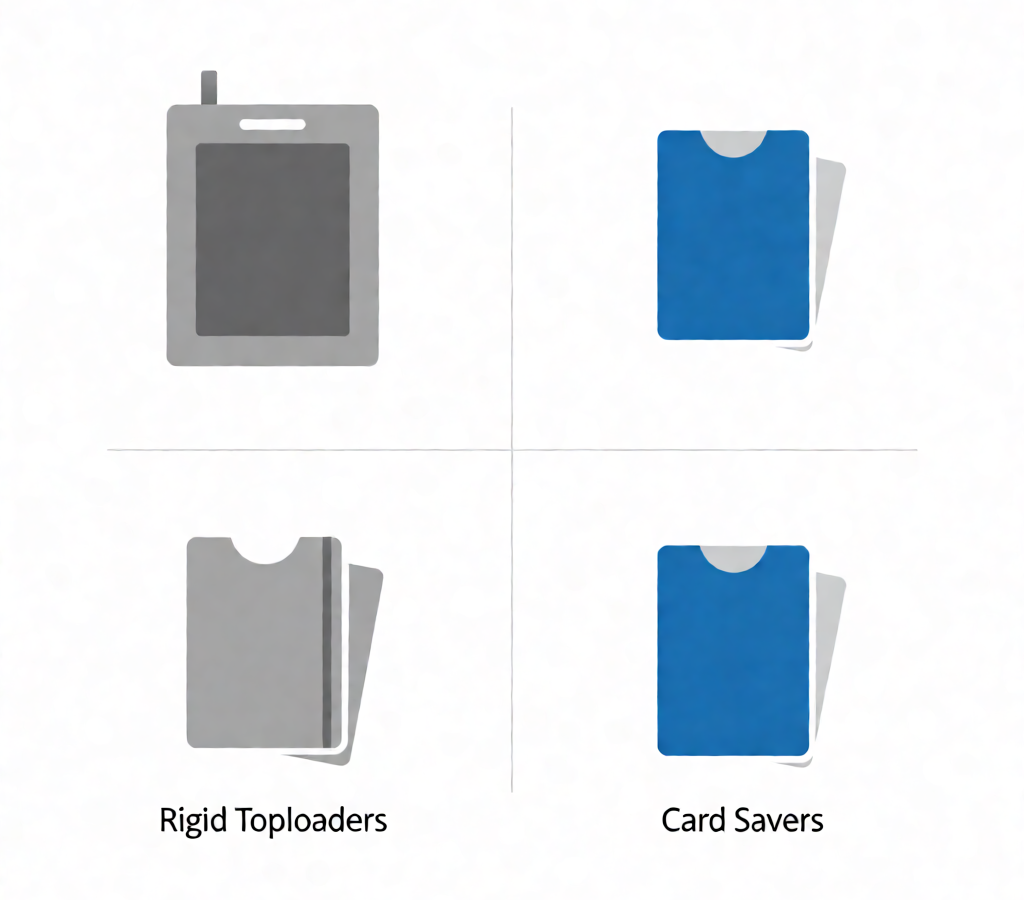
At a Glance
A rigid toploader is a stiff, thick plastic sleeve that provides structural support and premium protection. A card saver is a softer, thinner, flexible sleeve designed for budget-friendly daily protection of raw or ungraded cards.
Choose a rigid toploader when you need maximum protection — for graded slabs, high-value cards, long-term archival storage, or any card you want to preserve in the best possible condition.
Choose a card saver when you need affordable, lightweight protection for raw cards you handle frequently, trade, or store in bulk.
The rigid toploader vs card saver question ultimately comes down to one thing: how much do you value protection versus cost and convenience?
Rigid Toploader vs Card Saver — Key Differences
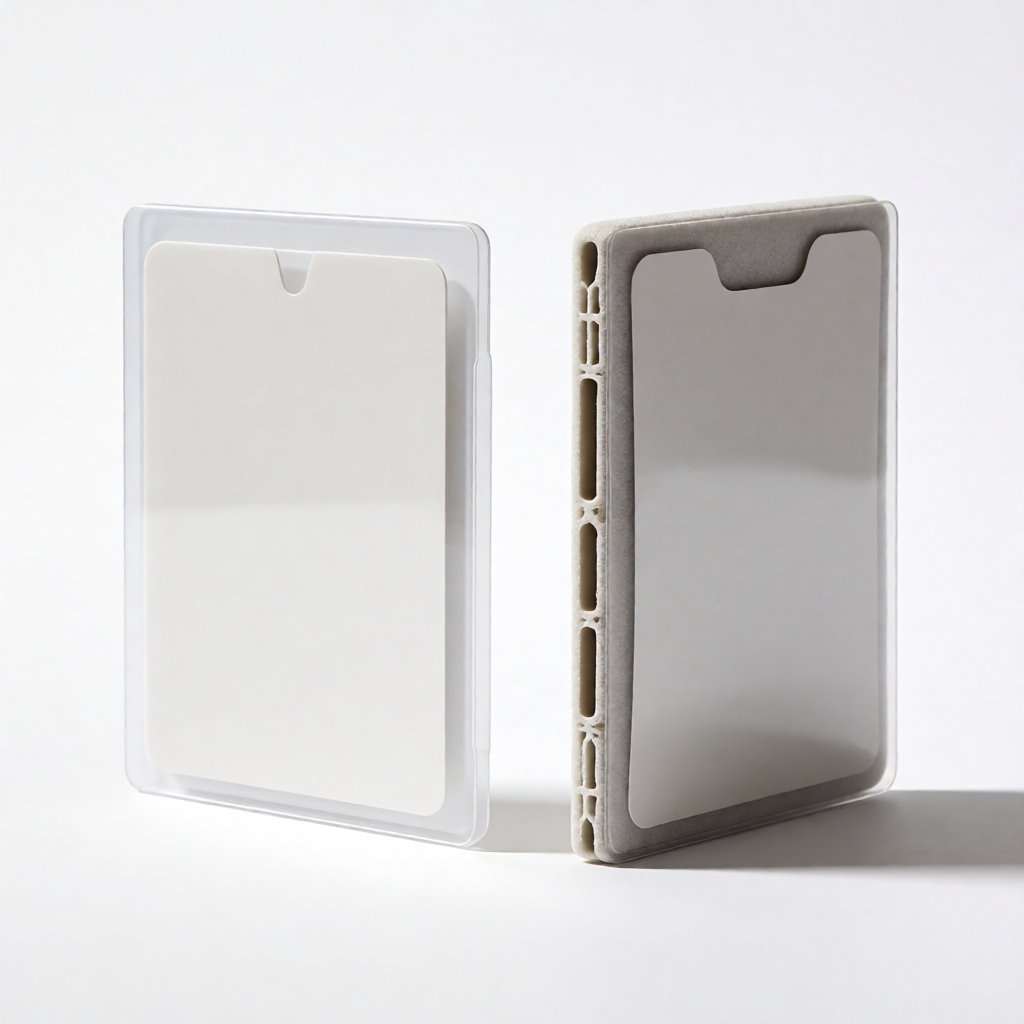
What Is a Rigid Toploader?
A rigid toploader (also called a top loader or gem protector) is a stiff plastic sleeve made from polypropylene (PP) or polyethylene terephthalate (PET). It is designed to prevent bending, creasing, and corner damage by providing full structural rigidity around the card.
Standard rigid toploaders for trading cards measure 2.5 × 3.5 inches to fit baseball and sports cards, with heavier-duty versions available for larger formats. Common thickness specifications include 20 pt (approximately 0.5 mm) and 30 pt (approximately 0.75 mm), with 30 pt being the preferred choice for slab guards due to its superior resistance to flex and impact.
The key advantage of a rigid toploader is that it does not collapse under pressure. When stacked in a box or carried in a binder pocket, it maintains its shape and keeps the card flat. This is why collectors who submit to grading services like PSA, Beckett, or SGC almost always use a rigid toploader as the first line of defense before placement in a slab.
What Is a Card Saver?
A card saver is a thinner, semi-rigid to flexible plastic sleeve typically made from PP or PET. The name “card saver” comes from its role as an economical protective layer — it prevents surface scratches, light scuffing, and minor handling damage without the bulk or cost of a rigid toploader.
Standard card savers are approximately 10 pt thick (around 0.25 mm), which makes them thin enough to slide into binder pages, trading boxes, and card bags without adding significant volume. They provide basic protection but offer no meaningful resistance to bending or corner crushing.
Card savers are the go-to choice for raw cards that change hands frequently — cards you trade at the local game store, rotate through your binder, or flip through during casual play. They are also commonly used as a first protective layer inside a rigid toploader for collectors who want double protection without switching to a more expensive product.
How Do They Compare Side by Side?
The most useful way to evaluate rigid toploader vs card saver is to look at the specific dimensions that matter for protection, handling, and cost.
| Specification | Rigid Toploader | Card Saver |
|---|---|---|
| Thickness | 20–30 pt (~0.5–0.75 mm) | ~10 pt (~0.25 mm) |
| Material | PP or PET | PP or PET |
| Rigidity | Fully rigid, maintains shape | Semi-rigid to flexible |
| Protection level | High — resists bending, impact, corner damage | Low to moderate — resists scratches and scuffs |
| Clarity | Excellent (especially PET) | Excellent (especially PET) |
| Insertion difficulty | Moderate — requires care to avoid bending the card | Easy — slides in quickly |
| Binder compatibility | Does not fit in standard binder pages | Fits in standard 9-pocket binders |
| Best for | Graded slabs, high-value raw cards, archival storage | Raw cards, daily handling, trading, bulk protection |
| Typical wholesale cost | $0.04–$0.12 per unit (bulk) | $0.01–$0.04 per unit (bulk) |
These numbers are indicative wholesale ranges for bulk orders. Actual pricing depends on material, thickness, quantity, and supplier.
Which One Is Right for Your Cards? — Use Case Guide
Graded Slab Protection
If you own a PSA, Beckett, SGC, or CGC graded slab, the answer is straightforward: use a rigid toploader — specifically a slab guard designed to fit the dimensions of the graded case. A card saver will not provide adequate protection for a slab, as it offers no structural support against drops, pressure, or stacking.
When selecting a slab guard, ensure it matches the exact dimensions of your slab. Most grading companies produce slabs of consistent size, but variations exist between PSA, BGS, and SGC cases. A proper-fit slab protector should slide on snugly without excessive play, and it should not obstruct the label or certification number.
For raw cards you intend to submit for grading, use a rigid toploader throughout the entire submission process. Grading companies expect submitted cards to arrive in toploaders, and submitting a raw card without one can result in damage during transit or inspection.
Raw Cards — Daily Handling and Trading
For raw cards that you regularly handle, trade, or rotate through your collection, a card saver is the practical choice. The lower cost allows you to protect large volumes of cards without a significant investment, and the slim profile means you can store them in binders or boxes without taking up extra space.
If a card has moderate to high value and you want additional peace of mind, you can use both products together — insert the card into a card saver first, then slide that into a rigid toploader. This combination is common among serious collectors because it adds a scratch-resistant inner layer while maintaining the structural protection of the toploader.
Long-Term Archival Storage
For cards you want to preserve for years or decades, a rigid toploader is the minimum standard. The rigidity prevents bending over time, and when combined with acid-free storage boxes and controlled environmental conditions, it provides a strong foundation for long-term preservation.
A card saver alone is not sufficient for archival storage. Over time, the flexible sleeve can allow the card to shift and flex, leading to cumulative stress on the corners and edges.
Display and Photography
When displaying cards or photographing them for sale, clarity matters. PET toploaders and PET card savers offer superior optical clarity compared to PP variants, with less yellowing and fewer surface distortions. If the visual presentation of the card is a priority, choose PET for either application.
Buying Factors — What to Look For
Material: PET vs PP
The material choice is one of the most important factors when comparing rigid toploaders and card savers.
PET (polyethylene terephthalate) is harder, clearer, and more chemically stable than PP. It resists yellowing over time and maintains its rigidity longer. PET toploaders are the preferred material for high-end slab guards and archival storage. The trade-off is that PET is slightly more expensive to manufacture and can be more brittle under extreme impact — though for normal handling, this is not a practical concern.
PP (polypropylene) is more flexible and less expensive to produce. It is the standard material for most budget-friendly toploaders and card savers. PP toploaders are durable enough for everyday use but may show slight yellowing after several years. For card savers, PP is the dominant material because the flexibility is actually an advantage — it makes insertion easier and reduces the risk of card curling.
When sourcing protectors, ask manufacturers about the specific grade and thickness of material they use. ISO/IEC 14443 standards for proximity cards demonstrate how material specifications directly affect product performance — the same principle applies to card protectors, where clarity, rigidity, and chemical stability are determined by resin grade and manufacturing parameters.
Thickness and Gauge
Thickness determines how well a toploader resists bending and how much bulk it adds to storage. For raw cards, 20 pt toploaders are the standard — they provide good rigidity without being overly thick. For slab guards, 30 pt is the recommended minimum, as thicker plastic better resists the pressure of stacking and transport.
Card savers at 10 pt are thin enough to fit in binder pockets but thick enough to provide basic scratch resistance. Going thinner compromises protection; going thicker makes them incompatible with standard storage solutions.
Size and Compatibility
Standard baseball cards measure 2.5 × 3.5 inches. Full-size cards (like Magic: The Gathering or Pokémon) measure 2.5 × 3.5 inches as well, though some older or specialty cards vary slightly. Graded slab guards must match the exact outer dimensions of the grading company’s case — a poor fit can allow the slab to shift inside the protector, increasing the risk of damage.
Always verify dimensions before purchasing in bulk. Manufacturers should provide exact internal and external measurements for each product SKU.
Insertion Difficulty and Card Damage Risk
One practical consideration that buyers often overlook is the difficulty of inserting a card into a rigid toploader. Unlike card savers, which slide in with minimal resistance, toploaders require a firm but controlled push. Cards with curled edges, warping, or thick printing (such as alternate art foils) can be challenging to insert and may risk corner damage if forced.
A proven technique is to start at the short edge and press the card in gradually, using both thumbs to apply even pressure across the width. If a card is particularly difficult to insert, placing it in a card saver first can reduce friction and make the toploader insertion smoother.
Price & Cost Comparison
Bulk Pricing for Trade Buyers
The wholesale cost of rigid toploaders and card savers differs significantly, reflecting the material and manufacturing differences between the two products.
| Product Type | MOQ Tier | Indicative FOB China Price (USD/unit) |
|---|---|---|
| PP Card Saver, 10 pt | 500+ | $0.01–$0.03 |
| PET Card Saver, 10 pt | 500+ | $0.02–$0.05 |
| PP Rigid Toploader, 20 pt | 500+ | $0.04–$0.08 |
| PET Rigid Toploader, 20 pt | 500+ | $0.06–$0.12 |
| PET Rigid Toploader, 30 pt | 500+ | $0.08–$0.15 |
| Slab Guard (custom size) | 1,000+ | $0.10–$0.25 |
Indicative FOB China bulk-order pricing for trade buyers — not a retail price and not a binding offer; final pricing depends on quantity, specification and order schedule.
What Drives Price Differences
Several factors influence the cost of each product type:
- Material: PET costs more than PP due to higher resin prices and more demanding processing conditions.
- Thickness: Thicker toploaders use more material per unit and may require longer cycle times in injection molding.
- Customization: Custom sizes, private-label packaging, and special surface finishes (matte, anti-scratch coating) add to the unit cost.
- Order volume: Larger orders typically achieve better per-unit pricing due to economies of scale in production and reduced setup costs per batch.
For buyers evaluating cost per unit of protection, rigid toploaders deliver more protection per dollar spent on high-value cards, while card savers offer the lowest absolute cost for bulk raw-card protection.
If you are sourcing protectors for your brand or retail operation, you can request a bulk FOB quotation with your specific quantity and specification requirements.
Pros & Cons Summary
Rigid Toploader
Pros:
- Superior protection against bending, impact, and corner damage
- Maintains card flatness during storage and transport
- Compatible with slab guard use for graded cases
- PET variants offer excellent long-term clarity and yellowing resistance
- Professional appearance for display and grading submission
Cons:
- Higher per-unit cost than card savers
- Requires more effort to insert cards, especially thicker or warped ones
- Does not fit in standard binder pockets
- Adds bulk to storage boxes and shipping containers
Card Saver
Pros:
- Lowest per-unit cost for protective sleeves
- Easy and fast card insertion
- Fits in standard 9-pocket binders and trading boxes
- Thin profile allows high-density storage
- Can be used as an inner layer inside a toploader for double protection
Cons:
- Minimal resistance to bending or crushing
- Does not protect graded slabs
- Cheaper PP variants may yellow over extended periods
- Not suitable for high-value archival storage on its own
Evidence & Practical Notes
Field note: Many collectors who submit cards for grading report that the most common source of pre-grading damage is not the slab itself but the handling and insertion process — forcing a warped card into a tight toploader can create micro-fractures at the corners that grading services will penalize.
Practical limitation: There is no universal thickness standard for trading card toploaders across manufacturers. A “20 pt” toploader from one supplier may measure slightly differently from another, and slab guards must be matched to the specific grading company’s case dimensions, which are not always identical between PSA, BGS, and SGC.
Buyer takeaway: If you are buying for personal use, match the protector to your primary use case — rigid toploader for valuable or graded cards, card saver for raw cards you handle regularly. If you are sourcing for resale or private label, request exact dimensional specs and material certificates from each manufacturer before placing an order, and consider ordering samples to test insertion ease and clarity before committing to volume.
Choosing a Reliable Manufacturer — What Quality Looks Like
When you move from buying single units to sourcing protectors in bulk — whether for your own brand, a retail operation, or private label — the evaluation criteria shift from individual product features to manufacturing capability and quality consistency.
Here is how the industry works and what to look for in a supplier. A quality manufacturer produces protectors with consistent thickness across every unit in a batch, maintains tight tolerances on internal dimensions so that slabs and cards fit properly, and uses materials that meet clarity and chemical stability expectations. Surface defects like scratches, cloudiness, or warping should be minimal — these are indicators of poor molding conditions or inadequate post-processing.
Reputable manufacturers operate under documented quality management systems. ISO 9001 certification covers the processes that ensure consistent output, and IATF 16949 certification — the automotive-grade quality standard that many precision plastics manufacturers hold — reflects a deeper level of process control, defect tracking, and corrective action methodology. These certifications matter because they signal that the manufacturer has systems in place to catch problems before they reach your order.
Manufacturing capability also includes the ability to produce custom sizes and specifications. Injection-molded PET and PP protectors require CNC-machined molds, and a manufacturer with in-house mold making can adjust dimensions, thickness, and surface finish without outsourcing — which reduces lead time and improves quality control. For buyers who need slab guards sized to specific grading company cases, or toploaders with custom branding and packaging, this capability is essential.
As a manufacturer, our approach to this is grounded in vertical integration — from resin selection and CNC mold production to surface finishing and quality inspection, all under one roof. This allows us to maintain tight dimensional tolerances, offer OEM and ODM customization for private-label buyers, and meet the specifications that serious collectors and retailers expect. We hold ISO 9001 and IATF 16949 certification, and our facility produces 500,000 units per month across graded card protectors, slab guards, corner protectors, and top loaders.
If you are evaluating manufacturers for your next order, we welcome the opportunity to discuss your specifications. Contact our team to share your requirements and receive a tailored quotation.
Sources & References
- ISO/IEC 14443 — www.iso.org
- request a bulk FOB quotation — topcardcase.com